
(15 October 2025 – United States) US banking regulator the Office of the Comptroller of the Currency (OCC) has awarded conditional approval to new digital bank Erebor backed by Peter Thiel and co-founded by major Trump donors Palmer Luckey and Joe Lonsdale.
Since the 2008 global financial crisis (GFC) the United States (US) has seen very few new banks enter the market. Now however the landscape is changing rapidly as a result of President Trump’s light touch on banking regulation.
Erebor said in its charter application that it would offer “virtual currency-related products and services” as well as traditional banking.
Like Luckey’s Anduril, a defence tech startup, and Thiel’s and Lonsdale’s Palantir, Erebor’s name comes from the J.R.R. Tolkien books. The bank is touted to become a successor to Silicon Valley Bank (SVB), which was the bank of choice for tech startups before a bank run led to its US$209 billion collapse in March 2023.
“I am committed to a dynamic and diverse federal banking system, and our decision today is a first but important step in living up to that commitment. Today’s decision is also proof that the OCC under my leadership does not impose blanket barriers to banks that want to engage in digital asset activities” OCC Jonathan V. Gould said in a statement.
“The target market for the Bank comprises businesses that are part of the United States innovation economy, in particular technology companies focused on virtual currencies, artificial intelligence, defence, and manufacturing, as well as payment service providers, investment funds and trading firms including registered investment advisers, broker dealers, proprietary trading firm, and futures commission merchants” the group said in a statement
“Since the GFC we have had very few new banks because Dodd-Frank made it more expensive to start one, scale became critical in a way that shut out small entrants, the prevailing low-interest-rate environment made banking margins unattractive, most Fintechs actually benefited from not being banks, because of Durbin where scaled banks make less per card swipe than smaller banks that Fintechs partner with, but most importantly, the OCC simply wasn’t granting very many new charters” commented Better Tomorrow Ventures Co-Founder, Sheel Mohnot.
“Now the landscape is shifting. Regulators are signalling a friendlier posture, with the OCC and FDIC saying they want more de novos. Congress is pushing too as the rise of stables means we’ll need regulated, trustworthy banks to custody reserves and provide payment access.”
“Fintechs that avoided charters are now seeking them for a variety of reasons, some to get direct access to payment rails, some just because working with partner banks was so difficult. Every marketing message has to get approved through some convoluted system and each new ad takes weeks to get approved. The combination is finally reopening the door to new bank formation. We’re going to see a lot of new banks in the coming years; the door is open.”
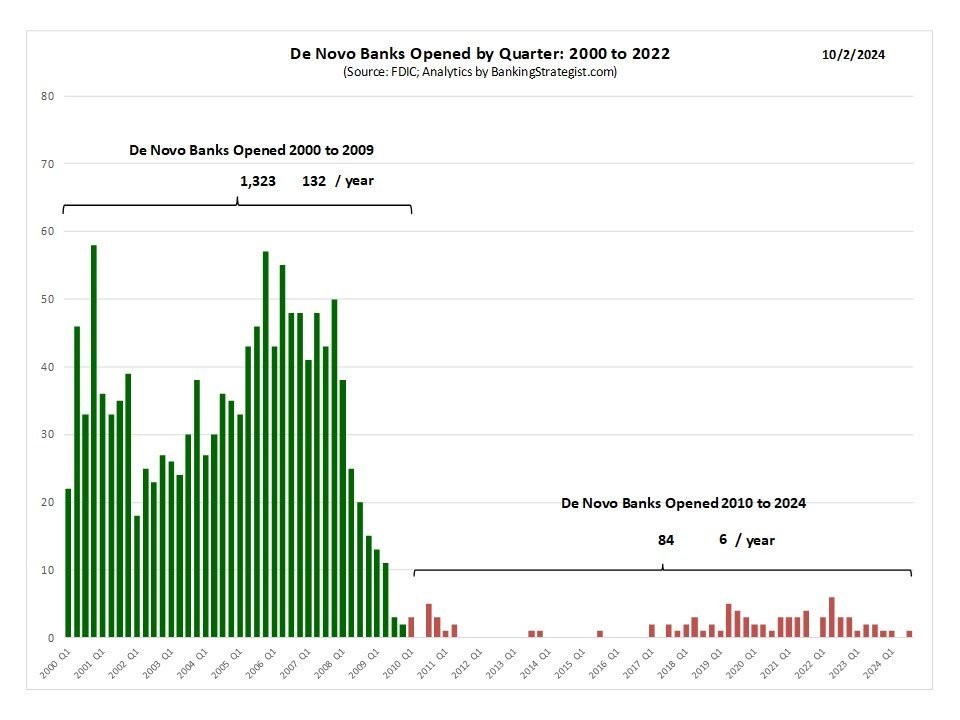
Source: FDIC, BankingStrategist.com