
(16 February 2026 – Australia) As productivity stalls, investment slows and red tape mounts, Australia risks falling further behind global rivals without urgent reform, Capital Brief reports.
The Reserve Bank of Australia’s (RBA) forecast for economic growth across the medium term was the lowest growth forecast the bank has ever delivered. In short, The Australian’s Simon Benson writes that Australia not only faces a rising interest rate environment, inflation dragging on for two years longer than promised and productivity “in the toilet”, but now the economy also is grinding to a halt. “On what planet could a government expect to escape intense scrutiny for such an abysmal outlook?”
“The RBA’s forecasts make for pretty unhappy reading. Unemployment is set to grind higher as inflation gradually grinds lower, while the current pick-up in economic growth is set to peter out fast, dropping towards very weak rates” commented Rich Insight Economist, Chris Richardson.
“A more competitive tax and regulatory environment, faster and clearer approval pathways, credible long-term policy signals and a workforce equipped for a technology-driven economy are all essential to rebuilding momentum. If we act decisively, we can once again become a country that builds industries of global scale. If not, we will continue to stagger along at 30 kilometres an hour while the rest of the world accelerates” commented EY CEO Oceania & Regional Managing Partner, David Larocca.
“Productivity growth, or the lack of it, is now the defining constraint on our economic capacity. Unless we confront it directly, our national speed limit will keep falling. Australia’s economy is like a car struggling to reach 30 kilometres an hour. Push it to 40 and the strain becomes obvious much like my first car, a brown Datsun 200B that needed a service every time it was driven too hard.”
The International Monetary Fund (IMF) has issued a stern warning that the Australian federal government may need to step in and bail out heavily indebted states and territories such as Victoria and NT, asserting that Treasurer Jim Chalmers must limit state government spending that is effectively “crowding out” private investment while also overhauling property taxes.
The United Nation (UN) agency found that while Australia was adequately managing a soft economic landing, the country faced risks to its outlook skewed towards slower growth and higher inflation potentially leading to damaging stagflation. Australia’s reliance on direct taxes and high effective cost of capital hinders investment and productivity.
“Should state spending continue to accelerate, risks include inefficiency due to rising construction costs and additional credit rating downgrades leading to higher interest expenses. As the Commonwealth is viewed as a de facto guarantor of state debt by some credit rating agencies, higher sub-national debt could eventually impact Commonwealth borrowing costs” the IMF report said.
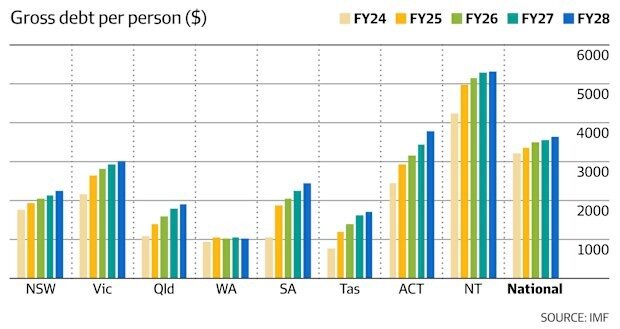
Source: AFR – John Kehoe
In a statement in response to the IMF report, Treasurer Jim Chalmers did not address rising state debt levels.
“The IMF lauded Australia’s economic performance, the government’s management of the budget and reform agenda. The three big economic priorities for the Albanese government this year and in the budget are addressing inflation, productivity and global uncertainty, and the IMF’s report shows why that’s the right approach” Chalmers stated.