
(28 May 2026 – Switzerland) 41 financial services companies have been selected to participate in ‘Project Agorá’, the major cross border payments tokenisation initiative announced earlier this year by the Bank for International Settlements (BIS).
Project Agorá (Greek for ‘marketplace’) will see the BIS and seven of the world’s most technologically engaged central banks including the Bank of Japan, Bank of England and Federal Reserve Bank of New York partner the private sector to explore how tokenisation can improve the functioning of wholesale cross border payments. The project is viewed by the BIS as having the potential to be the next frontier in a long trend of digitalisation of money.
The interoperable tokenised global wholesale payment architecture is built around tokenised reserves and tokenised deposits, importantly not stablecoins.
A newly released BIS report highlights how Project Agorá has successfully delivered a prototype that demonstrates that tokenised commercial bank deposits can be successfully combined with the trust and safety of tokenised central bank reserves on a shared platform. The prototype enables atomic, multi-currency settlement of wholesale cross-border payments which could occur on an around-the-clock basis if implemented.
“Atomic settlement” refers to cross border and cross currency transactions in the banking system that can be completed on an “all-or-nothing” basis as soon as key criteria have been met.
Although not a direct rival, Agora is compared to the mBridge digital payments project, led by China alongside Hong Kong, Thailand, the UAE and Saudi Arabia.
“Bringing together central bank money, commercial money and different assets on the same platform, all tokenised and interacting, opens up a whole new range of possibilities. This would be a game changer in how we think about money and how transactions take place” commented BIS Economic Adviser and Head of Research Hyun Song Shin.
“Tokenisation combines the record-keeping function of a traditional database with the rules and logic that govern transfers. With Project Agorá, we aim to improve existing capabilities and enable new ones, all based on the proven foundations of the two-tier monetary system with central banks at the core. These functionalities will come without sacrificing the safeguards on the integrity and governance of the monetary system.”
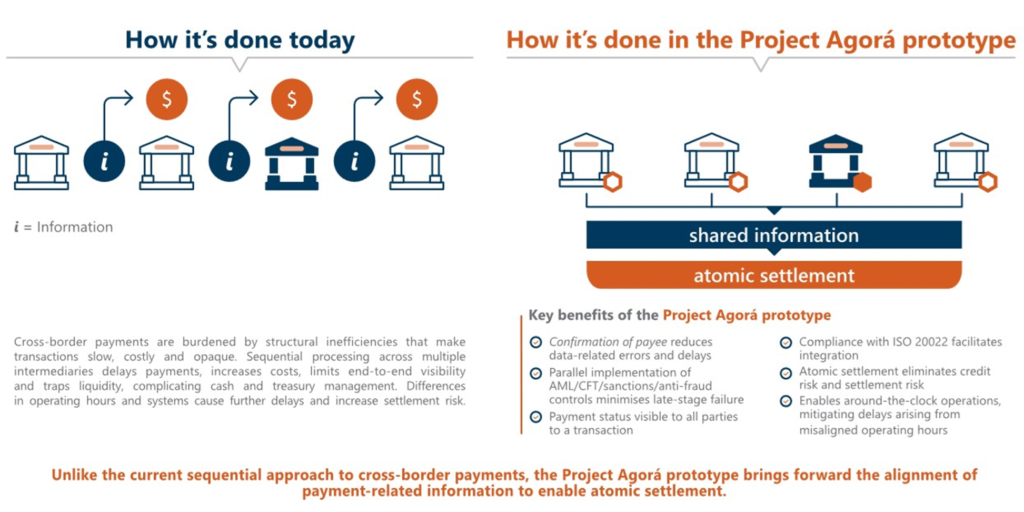
Source: https://www.bis.org/publ/othp110.htm