(30 March 2026 – Global) Gain valuable access to East & Partners global analyst team, sharing unrivalled insight into what is driving decision making among CFOs, treasurers and their financial services providers.
Key Competitive Differentiator – Risk Management Capability
As the financial markets “blast radius” from the Iran War, closure of the Strait of Hormuz and mounting geopolitical tensions the world over expand rapidly, corporates with established risk management strategies are well prepared for the unfolding “knock on effects” and growing risk of recession.
Risk Management has become so much more than a key competitive differentiator for leading corporates. A growing number of risk vectors threaten operational stability for treasury professionals and CROs across multiple areas including cybersecurity supercharged by AI, geopolitical threats, trade wars, supply chain disruptions, FX, inflation, interest rate risk and financial markets volatility in general.
From executive impersonation scams to AI-driven brute force attacks, social engineering and fraud losses now exceed US$1.1 billion per annum and the global cost of cybercrime forecast to surpass US$10.5 trillion this year according to Visa.
What risk management and hedging tools are the most effective for mitigating external and internal threats from a practical standpoint?
What are the most pressing challenges to financial risk management strategic decision making?
What impact does prudent risk management governance frameworks have on the bottom line?
Can CROs simply afford not to implement best practice frameworks to support execution and growth strategies?
Are pressing ESG imperatives being left behind as a wartime footing takes hold?
2026 is set to be a turning point in the approach to risk management as bottom line impacts pale in comparison to outright insolvency threats – which Banks are viewed by corporates as leaders in risk management relationship management and why? Tap into East’s voice of the customer analytics to discover more.
Correspondent Banking in Focus
The opaque world of cross border payments, correspondent banking and NOSTRO account management is a key focus area for Banks and corporates alike seeking to reduce costs and improve efficiencies. Will Stablecoins see Neobanks leapfrog antiquated processes? Ultimately the very drawbacks encountered with international money movement – lack of transparency, tracking and expense – are associated with the very strengths large corporates rely on from traditional bank majors – reliability, safety and security. Is a tipping point on the horizon however?
In 2019 the entire stablecoin market was worth less than US$2 billion – transaction volume now exceeds US$27.6 trillion, representing more than Visa and Mastercard volumes processed combined. While Stablecoin market capitalisation crossed US$300 billion, volumes represent a mere one percent of global payment flows, for now…
While most banks report their core banking systems and infrastructure is “ready”, veritably none have deployed stablecoins at scale however this is set to change quickly according to S&P with the emergence of “Stablecoin Banks”. Bank of America has declared entry into stablecoins is a matter of “when, not if” despite Visa executives rating institutional Stablecoin adoption on a scale of 1 to 10 as a paltry 0.5.
As PayPal rolls out PYUSD to users across 70 markets, extending availability beyond its initial US launch in 2023, are Stablecoins the most important evolution in cross-border payments since Swift or yet another “too hard basket”?
Will China’s CIPS payment system rival to Swift GPS gain greater traction?
Zero-Trust Supply Chains to Connect a Fractured World
Geopolitics is increasingly volatile yet some of the most important developments in trade are not political but in fact digital, seeking to ensure that companies know who, or what, they are really doing business with. T3i Partner Network’s Daniel Cotti and Michael Vrontamitis tell Financial World that there are new approaches to a zero-trust digital architecture in trade that aim to break through the siloed nature of blockchain projects devised to enable trust across a decentralised network.
The global trade and supply chain ecosystem is undergoing a profound transformation. Each day, billions of documents are exchanged across industries and borders, yet much of this communication still relies on outdated formats such as paper and PDF. These formats lack the interoperability, security, and legal certainty needed in today’s complex and fast-moving trade environment.
In theory, it does away with the need for an intermediary like a bank as all transactions are immutably recorded on the ledger. The International Secure Trade Transfer Protocol (ISTTP) P2P messaging system launched by the Verifiable Trade Foundation enables firms to “connect once, connect everywhere” without a central database or a distributed ledger.
“There are a lot of discussions around how to do finance in a more digital way. A core part of that is digital identity because as a lender you want to know who you’re lending to, not just the company registration number, but is the person on the other side really authorised and empowered to represent the company?” commented T3i Partner Network Founding Partner, Michael Vrontamitis.
“GLEIF, the NFP that was set up following the GFC to give businesses one legal identity worldwide and the legal entity identifier (LEI) have not scaled as many originally hoped. One practical challenge is that LEIs require annual renewal, and a meaningful proportion lapse over time as there is a cost to issue and renew them” stated T3i Partner Network Founding Partner and former board member at GLEIF, Daniel Cotti.
New Business Investment Helping Lift Productivity
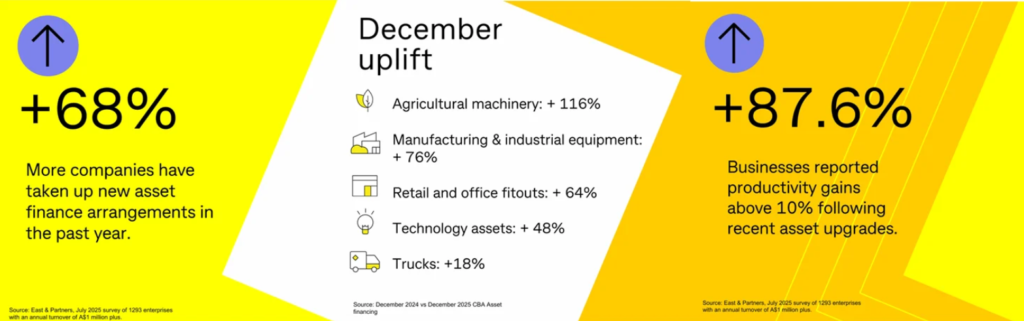
More enterprises are achieving productivity gains from upgrading old equipment, tech, and vehicles, with the Agriculture and Manufacturing sectors leading a recent investment surge.
New CommBank Asset Finance data based on proprietary East & Partners research shows nearly nine in ten firms have lifted output by more than ten percent following recent investments. Larger sized firms are capturing the biggest uplift, with more than half reporting productivity improvements of 20 to 50 percent, driven by newer, more efficient equipment.
Australian businesses are reporting major productivity gains after upgrading vehicles, machinery and technology. CBA recorded a 20 percent year-on-year increase in vehicle and equipment financing in December 2025 while 88 percent of enterprises reported productivity gains above ten percent following recent asset upgrades.
“A surge in December financing is typical end‑of‑year activity, but in 2025 it was happening at a much higher level. The end of the year is often an attractive time to purchase, with suppliers offering incentives to move existing stock ahead of new model launches. This allows businesses to secure better pricing and begin the new year with upgraded equipment ready for work” stated CommBank General Manager of Asset Finance, Renee Theodor.
“More businesses are planning investments in hybrid and electric vehicles, earthmoving equipment and office technology this year as they focus on productivity and efficiency” Theodor added.
February Analyst Meeting Insights Summary
The February 2026 analyst meeting insights encompassed major commercial banking thematics influencing markets including:
- Cross border payments vs FX perceptions
- Stablecoin developments
- Islamic finance growth
- Supply chain finance in the age of AI.
The most powerful near-term thought leadership opportunities are emerging at the intersection of FX, cross-border payments and stablecoins, in particular whether stablecoins can meaningfully unlock trapped NOSTRO liquidity and solve real corporate pain points, rather than just generate hype.
Top Into the Voice of the Treasurer – East on Demand
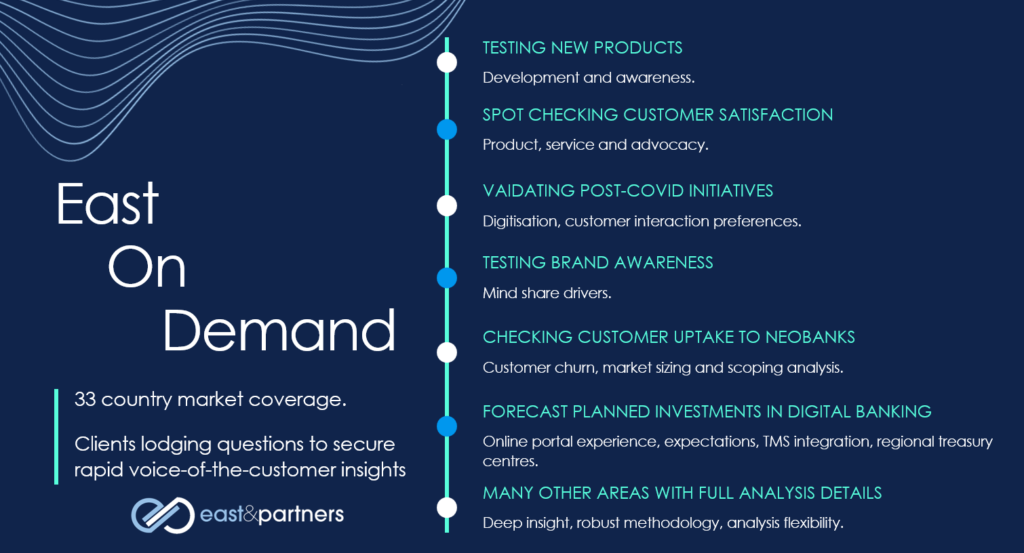
Generate turnkey solutions for these evolving, difficult to quantify thematics with the East on Demand platform.
Monthly fieldwork enables clients to directly interrogate CFOs and treasurers on any question, in any market with rapid voice of the customer insights generated within two weeks.
Clients utilise the platform for quickfire thought leadership and marketing campaign proof points and support, product and service development, defining a new business case, driving sales pipelines, forecast customer needs and much, much more.
Get in touch to find out what we would ask if we were in your shoes – East analysts compile a quarterly list of questions inspired by our unique understanding of the market, driven by client conversations, corporate interviews and market movements.