
(27 February 2026 – Global) East & Partners global analyst meeting insights share valuable insights from the team based across Australia, Hong Kong and the United Kingdom. East’s monthly analyst meeting summary provides a detailed breakdown of emerging behavioural trends among CFOs, corporate treasurers and key decision makers identified by East’s financial services clients and voice of the customer research.
FX & Cross Border Payments – One and the Same or Separate Functions?
While banks clearly delineate between FX and cross border payments functions distinctly, do corporates also interpret it this way? How does this differ by business size and how much do small businesses differ from larger sized corporates?
Stay tuned for newly released analysis delving into how Australian importers and exporters view cross border payments and associated FX managed and costed as one combined function, or as two distinct functions, home or recipient currency preference and current/forecast cross border payment methods that importantly captures stablecoin uptake and underlying demand.
Can Stablecoins Release US$800b in Trapped NOSTRO Liquidity?
Swift cross border payment flows through complex correspondent banking networks remain a major frustration for both banks and end user corporates with an estimated US$800 billion trapped in NOSTRO accounts globally. While consolidation is taking place as correspondents have declined by 12 percent in the last decade, cross border flows of over US$150 trillion continue to hit bottlenecks resulting in frustrating tracking and settlement delays.
McKinsey suggests stablecoins offer a compelling alternative to traditional remittance channels, enabling near-instant cross-border transfers at a fraction of the cost. Global payroll and remittances accounted for US$90 billion in annualised stablecoin payments volumes, representing less than one percent of the more than US$100 trillion in total volumes from this segment. Stablecoins could address inefficiencies in cross-border payments and international trade, such as high fees and settlement delays. Early adopters are using stablecoins to streamline supply chain payments and improve liquidity management, especially for SMEs. McKinsey estimates that B2B stablecoin payments account for about US$226 billion a year, or about 0.01 percent of global B2B payment volumes of roughly US$1.6 quadrillion.
EY is more bullish, forecasting that up to ten percent of volumes will be channelled via stablecoins within four years and more than half of global financial institutions (FIs) are exploring stablecoins and 9 in 10 large FIs in G20 markets using or planning to use stablecoins with US$1.3T linked to actual settlement and not purely crypto trading linked.
“Cross-border isn’t expensive because technology is slow. It’s expensive because liquidity is fragmented. Global banks park hundreds of billions in NOSTRO accounts to make the choreography work. Correspondent relationships are shrinking, concentrating power in fewer hands. Retail customers often experience “OUR” pricing structures they don’t fully understand and the FX spread frequently outweighs the visible transfer fee” commented RollingFunds Head of Marketing & Partnerships, Nicholas Pinto.
Islamic Finance Volumes Exploding
Trade Finance Global (TFG)’s newly released Islamic Trade Finance guide highlights exciting developments in fast moving Islamic Finance markets, a fascinating area of research East & Partners have tracked closely for the last 12 years. Islamic finance assets are projected to reach US$9.7 trillion by 2029, almost four times their 2018 levels. Islamic receivables finance is the new frontier for banks, institutions, and companies alike, responding to firms’ need for trade financing in an ethically sound, internationally recognised, and Shariah-compliant
Volumes are trending sharply higher as evidenced by NAB’s Islamic finance for businesses expanding 28 percent year-on-year as more customers seek out tailored financing options.
“More business customers are interested in this type of financing. More Muslim Australians are looking for business funding that fits their values and beliefs. The growth we’re seeing shows just how much this offering has resonated with these customers” commented NAB Head of Islamic Finance, Dr Imran Lum.
“We’re proud to be the only major Australian bank offering specialised Islamic financing for businesses, and we’re excited to make it available to more customers. Not every business has property to use as security, that shouldn’t stop them from accessing the finance they need to grow. It’s also not just Muslim-owned businesses that are benefiting from this product. In many cases, we have financed non-Muslim businesses that have requested this type of financing because they have a Muslim partner or investors with a preference for Islamic financing.”
Durable Global Trade in the Age of AI – Citi GPS
The latest 2026 Citi GPS Supply Chain Finance report examines the shifting dynamics of global trade that endures against a backdrop of volatility, forcing CFOs to assess real outcomes of tariff policy and the rapid proliferation of AI. Featuring East & Partners research based on direct interviews with 700 large corporates globally, the latest Citi GPS Report Supply Chain Financing – Durable Global Trade in the Age of AI finds global trade and geopolitics are more closely intertwined with one another than ever before.
Export growth from North and East Asia has shifted towards more emerging economies in efforts to diversify customers while the US appears to have increased its imports from other regions faster than it has from North and East Asia. When asked how their companies have responded to tariffs, corporates were more likely to provide answers that centered around managing costs, liquidity and inventory.
Working Capital Directly Related to Funding Tariff Costs
% of Total
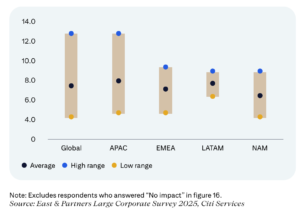
Citi GPS 2026 Report – Supply Chain Financing Durable Global Trade in the Age of AI (N: 710)
2025 reaffirmed that bond remains intact while technology – in particular AI and blockchain – has also had a profound impact on trade and supply chains. The analysis reveals a sharp increase in the number of treasurers using AI to manage a wide array of treasury functions and new applications of technology only continue to emerge.
“Disruption is no longer a bug in global trade – it’s a feature. The global trade landscape of 2026 is based on the new norm of trade incentives and barriers, geopolitical shocks and policy uncertainty that have created a markedly different environment” stated Citi Global Head of Trade and Working Capital Solutions, Adoniro Cestari.
“Trading relationships are being reassessed, supply chains are being reconfigured, and assumptions about efficiency, resilience, and risk rewritten. The picture that emerges from this report is neither complacent nor alarmist. Long-standing assumptions have been turned upside down, power is shifting, and the world is changing and AI will accelerate changes. For those ready to seize it, there are large opportunities for growth. Our aim in this report is to provide a clear-eyed, forward-looking perspective on how global trade is being reshaped, and why its capacity to survive, and to thrive, should not be underestimated.”
Overall, this year’s Supply Chain Financing report, following the 2025 GPS report Resilience, Opportunity and the Shifting Winds of Trade, encapsulates the state of global trade and how it may continue to evolve in 2026. Download the latest Citi Global Perspectives Solutions (GPS) report: https://www.citigroup.com/global/insights/supply-chain-financing-2026
January Analyst Meeting Insights
The January 2026 analyst meeting insights presented a key thematics for the year ahead including rising FX volatility, Banks ability to keep pace with evolving corporate financing trends and 2026 business banking outlook.
Top Into the Voice of the Treasurer – East on Demand
All of these complex, difficult to quantify questions are accessible from the East on Demand platform.
Monthly fieldwork enables clients to directly interrogate CFOs and treasurers on any question, in any market with rapid voice of the customer insights generated within two weeks.
Clients utilise the platform for quickfire thought leadership and marketing campaign proof points and support, product and service development, defining a new business case, driving sales pipelines, forecast customer needs and much, much more.
East analysts compile a quarterly list of questions inspired by our unique understanding of the market, driven by client conversations, corporate interviews and market movements.
Get in touch to find out what we would ask if we were in your shoes.